A Risk-First XAUUSD Trading Strategy
Most gold traders lose not because their ideas are bad, but because their risk is undefined. They know where they want price to go and have no idea what they'll lose if it doesn't. A good XAUUSD trading strategy flips that order: it defines the loss before the gain, every single time.
Below is a clean, repeatable, risk-first framework for trading gold. It's not a magic entry — it's a process you can run on your best and worst days without changing your behaviour.
The core idea: define the loss before the gain
Before you think about profit, you answer two questions: where am I wrong, and how much does being wrong cost? If you can't answer both, it isn't a trade yet. Everything below is built around protecting that answer.
Step 1 — Establish the higher-timeframe bias
Zoom out first. On the 4-hour and daily charts, decide whether gold is trending, ranging, or turning. Simple, objective tools work best: market structure (higher highs/lows vs. lower highs/lows) and a couple of moving averages for slope.
Your job on the lower timeframes is then to trade with that bias, not against it. Fighting a strong higher-timeframe trend in XAUUSD is the most expensive habit in gold trading.
Step 2 — Trade in the right session
Bias tells you what; the clock tells you when. A valid setup in a dead session often just bleeds. Concentrate your risk in high-liquidity hours — especially the London–New York overlap. (Full breakdown in our guide to the best time to trade gold (XAUUSD).)
Step 3 — Mark the levels that matter
You only need a few, drawn in advance:
- Prior day high and low
- Obvious swing highs/lows and support/resistance
- A supply/demand zone or a key Fibonacci level in line with your bias
These are your decision points. If price isn't at one of them, there's nothing to do yet.
Step 4 — Wait for a trigger
At your level, wait for confirmation on a lower timeframe (e.g. a rejection wick, a break-and-retest, or an engulfing candle) before committing. The trigger is what turns a zone into an entry.
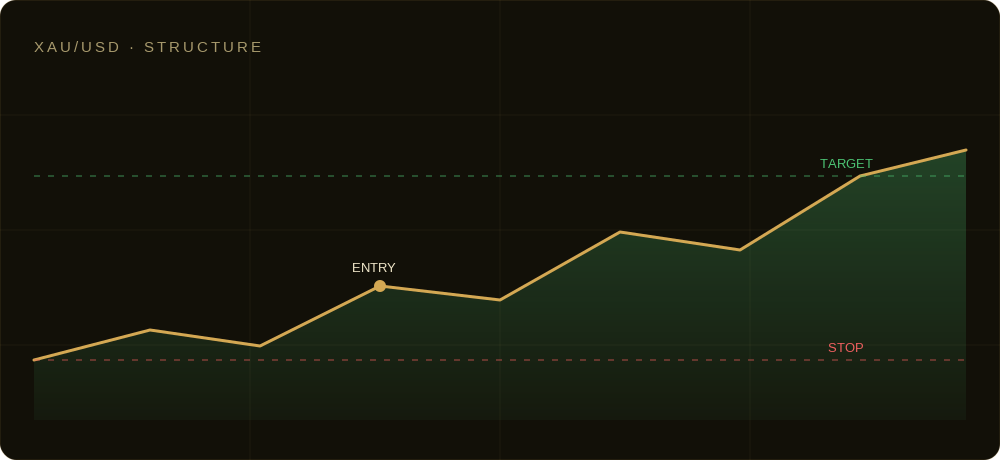
Step 5 — Place the stop where you're wrong
Your stop is not a suggestion — it's the definition of "the idea failed." Place it beyond the level that invalidates the setup (below the demand zone, above the swing high), with a little room for noise. A useful anchor is a multiple of recent range or ATR so the stop reflects current volatility, not hope.
Only once the stop is set do you know your risk in dollars per unit — and only then can you size correctly.
Step 6 — Size the position to a fixed risk
This is the step that keeps you in business. Risk a small, fixed percentage of your account per trade (commonly 1%), regardless of how confident you feel.
For XAUUSD, a standard lot is 100 troy ounces, so a $1.00 price move ≈ $100 per standard lot (a mini lot is ~$10, a micro ~$1). Position size is simply:
Position size = (Account × Risk %) ÷ (Stop distance in $ × $ per point per lot)
Worked example at 1% risk:
| Account | Risk (1%) | Stop distance | Loss per 1.0 lot | Position size |
|---|---|---|---|---|
| $5,000 | $50 | $4.00 | $400 | 0.12 lots (12 oz) |
| $10,000 | $100 | $5.00 | $500 | 0.20 lots (20 oz) |
| $25,000 | $250 | $3.00 | $300 | 0.83 lots (83 oz) |
Notice the target price never entered the calculation. The market decides your reward; you decide your risk.
Step 7 — Manage targets in R-multiples
Express targets as multiples of your risk (R). If your stop is $5.00 away, that distance is 1R. A first target at 1R lets you de-risk (move the stop to breakeven, take partials), while a runner aims for structure — the next swing or the prior day's extreme — at 2R or 3R. Over a series of trades, a positive risk-reward with a modest win rate is what compounds; no single trade should matter much.
Risk note: gold moves fast around US data (NFP, CPI, FOMC). Stops can slip through news, and no setup is a guarantee. Treat every level as a probability, not a promise.
The discipline layer: traffic-light + multi-timeframe
The framework is simple; running it consistently under pressure is the hard part. That's the layer SetupSift is built for: it reads XAUUSD across multiple timeframes, scores each setup with a green/amber/red traffic-light safety rating, and lays out the exact entry, stop and layered targets — the same risk-first structure above, checked for you before you act. It never places trades; you stay in control of every decision.
Frequently asked questions
What is a good XAUUSD trading strategy? One that defines risk first: establish a higher-timeframe bias, trade it in a liquid session, wait for a trigger at a key level, set a stop where the idea is invalidated, and size to a fixed percentage of your account.
How much should I risk per gold trade? A common, conservative rule is 1% of account equity per trade, kept fixed regardless of conviction so no single loss can do serious damage.
What is a good risk-reward ratio for gold?
Many traders look for at least 1:2 (risking 1R to make 2R). Combined with a realistic win rate, a positive risk-reward is what makes a strategy profitable over time.
How do I set a stop loss on XAUUSD? Place it beyond the level that proves your idea wrong, sized to current volatility (e.g. an ATR multiple), then let that distance determine your position size — not the other way around.
Put the framework to work
A strategy you actually follow beats a clever one you abandon under pressure. Trade it in the right session, keep your risk fixed, and let the process do the work.
Want the bias, session quality and exact levels scored for you in real time? Start free with SetupSift — or see what's included on the pricing page.
SetupSift is an educational analysis platform, not financial advice. Trading XAUUSD and leveraged products carries a high level of risk and may not be suitable for all investors. Past performance does not indicate future results.